Thursday, November 22, 2007

The Rape of Dinah/The Danger of Silence (Vayishlach)

With the dissonance between the Hebrew and Gregorian calendars, topics covered in a given Parsha don't always mesh with the American holidays that fall during that week. As you celebrate the Thanksgiving holiday, cherish the experience, and be thankful that you live in a country where -- for all the political discord of recent years -- you're living in a country whose soil has been untouched by war for more than a century* and guarantees freedoms to organize, to report and to speak out against that which you don't believe in. First-time contributor Eve's Apple e-mailed me the following commentary, inspired by this report (PDF).

I think when most people read about the story of Dinah, they are initially shocked and appalled by the act of rape itself. We tend to focus our anger mainly on Shechem, the son of Hamor, and contemplate how evil and arrogant he must be to kidnap and rape a woman just because he feels entitled to her.

However, when I read about Dinah’s rape this time around, I was more outraged by Jacob’s response than really anything else. One would think that as Dinah’s father, Jacob would be the most distraught and angered that his daughter has just been raped, but instead of wanting revenge for his innocent daughter’s rape, he is silent.

It truly baffles me how Jacob could remain so quiet and calm after his daughter’s rape. How can he be so silent in the face of tragedy? How could anyone be silent and not take a stand against the rape of the innocent?

I say this, and yet it occurs to me that we, as humans and Americans, are silent everyday as similar atrocities are happening around the world. Just look at the tragedy in Sudan. While there is still ridiculous debate amongst the international community about whether Darfur should be considered genocide, the bottom line is that as many as 400,000 civilians have been killed and up to 2.5 million Darfuris have been forced to leave their homes and now live in camps for internally displaced persons.

Call it genocide, ethnic cleansing, a crime against humanity…it really doesn’t matter what we call it, especially since right now, our silence is doing all the talking.

Now in its fourth year of violence, the U.N. has called Darfur, the world's “greatest humanitarian crisis,” and President Bush has come out and declared it to be genocide. So why then are thousands and thousands of innocent people being killed and raped every day?
“When my village was attacked, 30 men with guns entered in the village. Some of them found me in my house. Three of them raped me and I fell unconscious. The men locked me inside my house (straw hut) and set it on fire. I managed to get out of the house through the burning grass.”
--Woman, 17, October 2004, West Darfur
In Darfur, rape is used as a weapon of war. The Janjaweed rape the Sudanese women as a way to violate their human rights, and also as a way to humiliate her husband, her family and her community. Rapes are done in the open, to young girls, pregnant women, anytime, anywhere. If you resist the rape, then you are beaten and even killed.

"I was sleeping when the attack on Disa started. I was taken away by the attackers, they were all in uniforms. They took dozens of other girls and made us walk for three hours. During the day we were beaten and they were telling us: "You, the black women, we will exterminate you, you have no god." At night we were raped several times. The Arabs guarded us with arms and we were not given food for three days."
--A female refugee from Disa [Masalit village, West Darfur],
interviewed by Amnesty International delegates
in Goz Amer camp for Sudanese refugees in Chad, May 2004
Just like Dinah’s voice is never heard throughout Genesis, these women also usually remain silent about their rapes and beatings. During Dinah’s time, a woman would remain silent about a rape because it was considered an extremely shameful act. (The Law of Deuteronomy 22 and Exodus 22 explain that the rapists would have been expected to marry the woman he rapes, live with her and support her for the rest of her life.)

Likewise, in Sudan and in many Islamic countries, society views sexual assault as a dishonor upon the woman's entire family. Victims can face terrible ostracism and embarrassment if they come forward. Therefore, rape victims remain quiet in order to avoid stigma or further mistreatment. (Just listen to Aziza’s story, which almost completely parallel’s Dinah’s story.)

"I am 16 years old. On day, in March 2004, I was collecting firewood for my family when three armed men on camels came and surrounded me. They held me down, tied my hands and raped me one after the other. When I arrive home, I told my family what happened. They threw me out of home and I had to build my own hut away from them. I was engaged to a man and I was so much looking forward to getting married. After I got raped, he did not want to marry me and broke off the engagement because he said that I was now disgraced and spoilt. When I was eight months pregnant from the rape, the police came to my hut and forced me with their guns to go to the police station. They asked me questions, so I told them that I had been raped. They told me that as I was not married, I will deliver this baby illegally. They beat me with a whip on the chest and back and put me in jail. There were other women in jail, who had the same story. During the day, we had to walk to the well four times a day to get the policemen water, clean and cook for them. At night, I was in a small cell with 23 other women. I had no other food than what I could find during my work during the day. And the only water was what I drank at the well. I stayed 10 days in jail and now I still have to pay the fine, 20,000 Sudanese Dinars (65 USD) they asked me. My child is now 2 months old."
--Woman, 16, February 2005, West Darfur
After the Holocaust, the world said, “Never Again.” After the Rwanda genocide, we promised, “Not on Our Watch.” Genocide is happening and something most be done, more quickly and more forcibly before it is too late. I won’t pretend to have all the answers regarding this tragedy, and I realize that this is a complicated issue that can’t be solved overnight. But what I am 100% sure about is that silence is not an option. We can’t just sit back while innocent people are murdered and raped. This genocide has gone on long enough.
“In the end, we will remember not the words of our enemies, but the silence of our friends.”
--Martin Luther King, Jr.
*All due respect to Pearl Harbor, but I'm talking mainland.


Save to del.icio.us

Friday, November 16, 2007

Vayetzei: What's the deal with ladders anyway?


This is my first post. It's gonna be PACKED. Welcome to the party.

Let me start off by apologizing for the blatant Seinfeld-esque ripoff in the title. But hey, we're Jews, and it's what we do. Not necessarily rip things off, but quote Seinfeld. As it's currently very early in the morning, and I have no good transition sentence, let's just get to it and talk about ladders.

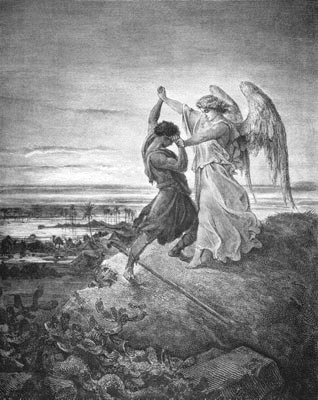
This week's Parsha, Vayetzei, brings us to some early but monumental incidents in the Torah. Jacob's dreams of the ladder to heaven and of wrestling with an angel of God are some of the most universally-known occurrences/legends in the history of mankind. Artists across time have used these dream-stream-of-consciousness passages to stylistically attempt an interpretation of the Torah's Word.

There are also several major issues surrounding these revelatory experiences. When Jacob puts down his head to rest, he (purportedly) lays it on the Foundation Stone, aka "The Place Where It All Began," and makes an altar there after he wakes from his dream. The stone would later become the site of the Temple in Jerusalem, and is currently being housed under the Dome of the Rock (so far, this is the closest I've been able to get). It is also in this Parsha that the name "Israel" is born. Heavy stuff. But I digress.

Jacob's dreams evoke several thoughts in my mind about the importance of ladders. Ladders, while are not inherently Jewish (there's a cave in Spain with a 10,000-year-old painting of people using a ladder), can play an important role in Jewish consciousness and thought. The Torah says that when Jacob looked up the ladder in his dream, he saw angels "ascending and descending the ladder" into Heaven, with the word "ascending" appearing first. But if angels originate in Heaven, how can they ascend first? Shouldn't they first be coming down? In the Midrash, writers for this passage concluded that since Jacob was a holy man, angels were always present around him, and therefore were able to ascend back to Heaven on the ethereal ladder while the other angels were coming down.

Some Jewish movements also believe that the path to true spirituality is related to climbing a ladder. Chabad philosophy (which Matisyahu claims is the "deepest well-spring") states that living a traditional Jewish life full of ritual and custom cannot come all at once, but gradually. Step-by-step, we can observe and celebrate the mitzvot to the best of our ability and/or level of devotion.

Then we have the old ladder clichés: The Corporate Ladder (which I'm currently trying to climb); The Social Ladder (which I gave up on around 7th grade - you should see my Bar Mitzvah pictures); and then there's The Ladder of Attraction (if you haven't read this theory, it's hilarious). What exactly are we reaching for? What is it about us that makes us always want to be in a different place? Shouldn't we just focus on the here and now? I don't know the answer.

I leave you with a video and song from one of my favorite bands, the now-defunct Agents of Good Roots. Aside from being an great tune with amazing instrumentation, the lyrics (which are printed below) are very poignant and touch on the same ladder themes that I have been discussing. Keep climbing, but once you get to the top, look out kid.


"Jakob" by Agents of Good Roots

Jakob's got a ladder
Climbs up to the sun
Once you get to the top of it
You're going to be someone

Now Ive got a ladder
And it climbs up to the sky
Once i get to the top of it
I'm gonna be good and high

Don't believe in ladders
Heaven ain't in the sky
But once you get to the top
Look out kid

(chorus):
Jakob keep climbing someday
You're gonna get to the top you see
You're living your life on earth
In a state of rebirth
The work is done and time will tell
If you're living in hell
This world is a heaven to me

Sharon's got a rose
Redder than her lipstick
Says, "brother can you spare a dime?"
And then i give it to her quick

Now I've got a rose
But the wine is dirty red
Drink enough for the both of us
In the morning i might be dead

Don't believe in roses
Heaven ain't in the sky
But once you get to the top
Look out kid

(chorus)

Joseph's got a coat
Covers up the back seat
Takes a hit of his smoke
Then he says he can't see straight
No, no

I've got a vision
Colors too bold to call
Big enough for the both of us
Big enough for us all

Don't believe in visions
Zion ain't in the sky
But once you get to the top
Look out kid


Save to del.icio.us

Thursday, November 15, 2007

Dizzy Dance (Vayetzei)


As the season of (selfless?) giving approaches, I begin to silhouette - as I do every year- my wants against my needs. I am sure that I’m not the only 20-something who has been spending the last 2 1/2 years in a perpetual state of transition and uncertainty, ultimately inducing a sense of powerlessness at the cruel "real world" that was much more glamorous on MTV. I’d be lying if I didn’t seethe with more than a tinge of jealousy upon reading God’s lifetime guarantee to Jacob in this week's Parsha, Vayetzei. For 18 years or so, I was used to someone ushering me across a stage and getting a rolled up piece of paper, marking one transition after another, until I reached the finish line in my bright purple cap and gown, before finding myself teetering on the edge of the Sidewalk in Shel Silverstein's imagination. Wake-up call after wake-up call, I’m slowly learning what it means to be an adult, without any of the cushy certainty that Jacob was afforded in this portion.

Like many youngins, I used to entertain myself on especially slow recess days by spinning around in circles in the schoolyard until I fell down. Doing what I called "The Dizzy Dance." While the nausea billowed up inside me, I still spun around with that reckless childhood abandon that comes only with the sense of invincibility and the guaranteed carton of milk and nap after lunch. And now, years later, it’s admittedly a exciting to have this world teeming full of possibility and change, but I often feel like I’m in a perpetual state of dizzily dancing, without a place to land. Unlike Jacob, who, amidst a journey of uncertainty, finds great solace and the drive to move forward when he realizes his bright future, and the guarantee of comfort and land. Some days I wake up afraid of how possible my future is, almost debilitated by it. If someone were to hold up even a vague image of continuity and certainty, I think I would have a different type of resolve - like Jacob’s- to act self-assured and stable in my decisions and life choices.

This brings me to my current state of affairs - I recently had to transition between jobs, overcome by opportunities to do service projects, either in my current city of residence or while traveling throughout the US. Each of which - a "big girl" job and a 10-month road trip - were never a part of the “What do you want to be when you grow up?” discourse that graced oh-so-many grammar school bulletin boards. Among pictures of veterinarians helping sick puppies and doctors taking temperatures, children are never taught to aspire toward finding self-satisfaction in unpredictability. I made my decision to start a new job - one that’s unconventional, and solely focused on a controversial cause. I’ll never know if giving up the cross-country trip was ultimately the right decision, and I can’t very well lay my head on a rock and suddenly feel comfortable knowing my future the way Jacob does. Instead, I find myself making decisions with the line between want and need blurred, and the image of my future submerged in a fog of risks.

That said, I’m fairly certain I wouldn’t trade it for anything. The upheaval of making myself dizzy is pretty self-destructive, but I guess always wanted to be the sole source of my undoing and personal evaluation. And that type of resolve, my friends, is the better than any gift God can dream up for you.


Save to del.icio.us

Wednesday, October 31, 2007

Tips From the Watering Hole - OR - How to find a nice Jewish Girl (Chayei Sara)

By Dr. Dreidel
(NOTE: This is THE Parsha that inspired The Watering Hole!)

The Torah. How can such an ancient document still be relevant to me today? It has been read, reread, and re-reread again. It has been debated over matzah, mannah, challah, bagels, burgers and burritos. It has been sermoned on to Orthodox Jews, Conservative, Reform, Hillelnicks, socialites, non-religious and the non-awake.

Yes, the Torah delivers to us values, rules and customs, but as a 20-something just out of college, looking to find my way, I need help getting a job, finding a mate, finding free places to download mp3s (Soulseek, but you did NOT hear that from me--ed.) and figuring out what I should do with my life.

And then I took another look at the Torah. I blew off the dust, talked to some friends, confirmed with my salsa bowl of advisers and realized that maybe Moses and crew knew a thing or two that could help this 20-something out.

This week Abraham needs to find his son a wife. A nice Jewish girl. So like any father he sends out his slave to another city, and tells him to wait by a well (watering hole!) and ask young maidens for water. The first girl to offer water for both the slave, Eliezer, and his camels wins Abraham's son's hand in marriage.

Bingo. Big wedding, Hora dancing, frat brothers as the groomsmen, glass is broken, son is married.

Rewind to the beginning - I think I noticed something. Here is the portion rewritten:

How to find a nice Jewish girl
by The Commissioner, Abraham and Eliezer

THEN
  1. Start with a father (Abraham) pressuring his son (Isaac) to find a NJG (Nice Jewish Girl).
  2. Go to the well watering hole.
  3. At the watering hole have in mind what you are looking for. Know the difference between a girl that offers water for you vs. a girl that will get water for your camels as well.
  4. Travel with Camels.
  5. Don't just go for the first girl you see. Wait for the one you want.
  6. It's OK for a girl to come up to you. And make sure she offers drinks for your camels.
  7. Make sure that you have someone to recommend her to your family.
  8. Get married, break a glass, dance the Hora. Amen.
NOW
  1. Start with your Jewish parents pressuring their son to find a NJG.
  2. Go to a place where you will encounter a lot of NJGs: Synagogue Young Leadership. Birthright. A Bar. (Only if it's here, ha.--ed.)
  3. At your location, have in mind what you're looking for. Know the difference between an IJC and a NJG.
  4. Bring your friends.
  5. Don't buy any girl that squeezes her arms together a drink. It's OK to be selective.
  6. The girl that you are really looking for will make an effort to befriend buy a drink for your friends. Even if they are camels in real life (they're ugly, they spit, they have humps).
  7. Make sure that you have someone to recommend her to your family.
  8. Get married, break a glass, dance the Hora. Amen.
SIDENOTE: The title of this Parsha is "The Life of Sarah." However, Sara dies in the first sentence, leaving the rest of the Parsha describing the search for a wife for her son, Isaac. This should not be ignored by a young 20-something male looking for a mate. A Jewish mother's job is not done until her son is married. And even then, this new woman in her son's life will never take precedent over her, the mother.


Save to del.icio.us

Friday, October 26, 2007

No Commentary This Week

Apologies for the lapse, but life got in the way of the Good Book, and we're taking an L on Vayera. We'll be back next week for Chayei Sara. Catch you then, kids.


Save to del.icio.us

Friday, October 19, 2007

Go! ... And I'll C U When U Get There! (Lech Lecha)


Casseopia touched on this earlier this week, but in Lech Lecha, Abram is just told to go. (Genesis 12:1) He's given no specifics, just a big picture promise that it's going to work out in the end, despite the possibility for complications in between. A blogging buddy of mine, Jess of What? The Curtains? recently pointed out this is an attitude that applies when it comes to baseball, particularly for fans of the New York Yankees:
It's like the Yankees and Red Sox play out almost every season this choice of how you can view your life. The Yankees are all optimism and certainty that things will work out in the end. As my friend Aaron once said: 'The Yankees are God's team.' The Red Sox are all insecurity and uncertainty and neediness. In constant doubt they are worthy of winning.

The cliche about baseball is that it's a marathon, not a race. In April, the Sox swept and then took two of three from New York. In August, the Yankees swept and now just wrapped up their two-of-three at Fenway. Perfect symmetry to prove how baseball gives everyone a chance at redemption (like Giambi on Friday after his botches), a chance to balance wins with losses when there are enough opportunities to play.

Sometimes I think we believe life is supposed to unfold in a particular fashion of wins and losses. That it is supposed to be a sprint to be the win we want. But usually things unfold in a much more complicated fashion. At least, the things worth fighting for do.
Complicated, but worth it ... that's life. And it's an outlook I share. I got facetiously annoyed at Jess because she successfully married my attitude on living to the one professional sports team I actively despise.

And this is relevant more than ever for me right now. I graduated college more than two years ago, holding an internship at MLB.com that I only scored after being rejected and then run through the ringer a month later, before I ended up covering the Mets and the Yankees. (It made no sense to me either.) They extended me through the playoffs (plus), but then only needed me to freelance four articles the entire offseason (minus). So I put my passion for reading to good use and got a job at Barnes & Noble. And was working there for eight months. Living at home. Applying unsuccessfully to the few sports journalism openings I came across.

And *WHAM*

My former editor tells me there's a new job at the Baseball Hall. I apply and within six weeks, I'm living in the Boondocks, not a person I know within four hours. But it turns out there's a spoken word poetry scene. And an unofficial chapter of my fraternity. And I wing it until it makes sense.

A year and five months later, I'm organizing the local poetry scene, have met enough people to claim 73 Facebook friends at SUCO, moved in with two people I met up here, and only get back to New York every few months, because I'm well established enough that it's an inconvenience.

And two months after I had finally refocused, preparing myself to be here through August 2008, and a college friend tells me to keep an eye out because some stuff is going down at NBA.com. And a few weeks later, there's an official job opening. And a week after applying, a friend hit me up on GChat for the first time in a while, mentioning she was searching for a job. I mentioned the NBA application, and she lets on that a former coworker and friend is now working in HR there. My stuff gets forwarded through again, with a CLUTCH referral, and I get a phone call the next business day, setting up an interview for this coming Monday.

Honestly, I have no idea what's going on. And it's still an offer away from being really real. And it's a position that could evaporate at the end of the NBA season next year. But the situation screams "GO!" Get to the Dirty Jerz, do how I do at this interview, and let the situation play itself out. All I can do is trust that one day, it'll all make sense.

And just like Jew No. 1, I'm down with that. Word to Old Abe. Knew what was good 6,000 years ahead of the game. He did how he do. I can only keep trying.


Save to del.icio.us

Wednesday, October 17, 2007

The Space Between (Lech Lecha)


From Casseopia:

I went to see a special screening of Wes Anderson’s newest film, “The Darjeeling Limited” a couple nights ago. You should go see the movie – it’s a great story about the search for spiritual connection. Wes Anderson was there, and so was one of his creative sidekicks, Jason Schwartzman (a Yid), for a Q&A session after the movie.

Both of these guys are geniuses in their own right, but Schwartzman gets honorable mention here for two reasons:
  1. His bangs take up so much forehead space they deserve their own area code
  2. He gives good advice.
This week’s Parsha, Lech Lecha, tells the story of the beginning of Abraham’s journey. Abraham (known as Avram at the beginning of the Parsha) is commanded to “Go!” God says, “Go from your land, from your birthplace, and from your father's house, [and go] to the land that I will show you.” (Genesis 12:1) Abraham complies, with only the promise of becoming the father of a great nation leading the way. God doesn’t tell Abraham where he’s going, God doesn’t tell him how long he’ll be gone, just that he needs to go. Now.

As someone who has followed in the hallowed footsteps of our wandering ancestors, I try to collect as many nuggets of truth as I can. Like Abraham, I don’t always have time to prepare for life’s twists and turns and it’s nice to know that at least I’ll always have a collection of wise thoughts in the back of my mind. These tidbits of advice are portable and they have served me well as guidelines along my own journey.

So naturally, I asked Jason Schwartzman to share some wisdom with me. As a writer and an actor, I figured he’d done some pretty deep thinking about life. He told me about a family trip he took as a kid to Italy, and a tender moment he shared with his mom in the Sistine Chapel. She pointed up at the ceiling and said to him, “You know how the fingers in the painting don’t touch? You see how they’re painted so that they are almost touching? No matter what you do in life, you should always leave room for the space between the fingers.” Did she mean space for God? Space for each other? Space for Natalie Portman? (If you’re a dude and a fan, see the movie.)

I don’t think we need to know what the space is for, as long as it’s there. As young Jews, we deal with a lot of variables in our lives, and we face big questions about our futures and our past. This week’s Parsha teaches that in dealing with these big questions and even bigger changes, we should leave room in our lives for spirituality and new opportunities.


Save to del.icio.us

Friday, October 12, 2007

The Death Star, Ark Parallels (Noach)

Imagine someone is building a gigantic ark. I mean, the Ark that Noah built had to be huge. Probably the size of a Carnival Cruise-liner. At some point, we have to realize that one person cannot do this alone. And unlike our friend Steve Carrell in Evan Almighty, we all know animals cannot hammer a nail.

Noah had three sons, but if they were so upset with him that they cut off his Peter Pecker after the flood was over, I doubt they were very helpful during the pre-flood efforts.

Looking for guidance on all this I turn to a personal wise man, Randal Graves, video rental salesman in the movie "Clerks," directed by Kevin Smith.

Here is what he had to say when discussing the second Death Star, in the Return of the Jedi:
Randal: So they build another Death Star, right?
Dante: Yeah.
Randal: Now the first one they built was completed and fully operational before the Rebels destroyed it.
Dante: Luke blew it up. Give credit where it's due.
Randal:And the second one was still being built when they blew it up.
Dante: Compliments of Lando Calrissian.
Randal: Something just never sat right with me the second time they destroyed it. I could never put my finger on it-something just wasn't right.
Dante: And you figured it out?
Randal: Well, the thing is, the first Death Star was manned by the Imperial army-storm troopers, dignitaries- the only people onboard were Imperials.
Dante: Basically.
Randal: So when they blew it up, no prob. Evil is punished.
Dante: And the second time around...?
Randal: The second time around, it wasn't even finished yet. They were still under construction.
Dante: So?
Randal: A construction job of that magnitude would require a helluva lot more manpower than the Imperial army had to offer. I'll bet there were independent contractors working on that thing: plumbers, aluminum siders, roofers.
Dante: Not just Imperials, is what you're getting at.
Randal: Exactly. In order to get it built quickly and quietly they'd hire anybody who could do the job. Do you think the average storm trooper knows how to install a toilet main? All they know is killing and white uniforms.
Dante: All right, so even if independent contractors are working on the Death Star, why are you uneasy with its destruction?
Randal: All those innocent contractors hired to do a job were killed- casualties of a war they had nothing to do with. ... All right, look-you're a roofer, and some juicy government contract comes your way; you got the wife and kids and the two-story in suburbia-this is a government contract, which means all sorts of benefits. All of a sudden these left-wing militants blast you with lasers and wipe out everyone within a three-mile radius. You didn't ask for that. You have no personal politics. You're just trying to scrape out a living.

So even though Noah was the only holy man left on Earth, what about all the people that he would need to build an ark that would last for an entire year, who then got washed away?


Save to del.icio.us

We the Undersigned, Moose and Squirrel (Noach)

Warning:

Global Warming is going to raise the water level across the world. Manhattan will be underwater. Miami will be underwater. Boston will be underwater. Kansas and Toto, however, will be fine.

The weather will change. Climate will change. The sky will look different. You will need a parka and suntan lotion simultaneously.

We call on the people of Earth to right their ways, take care of the planet and one another, otherwise we are facing a catastrophe unlike anything we have ever seen.

Signed,

Noah, Mrs. Noah. Noah’s Sons, Mrs. Noah’s Sons.

Mr. and Mrs. Gorilla, Mr. and Mrs. Lion, Mr. and Mrs. Bunny, Mr. and Mrs. Giraffe, Mr. and Mrs. Moo Moo Cow, a couple of birds, Mickey and Minnie Mouse, Moose and Squirrel, Chip and Dale.

Apparently this petition didn’t reach enough people of Earth, leading to a series of events in which an ark was built, the undersigned made it onto the boat and the world as we know it was washed away.

Can you imagine what it would be like for someone to preach to us that the world was coming to an end? All the Earth will be covered in water. The way we live will be put at risk. The future is unknown.

Who would listen to such conjecture?

I know what you’re thinking. Parsha Noach cannot truly be related to what we face today with Hurricane Katrina, the Tsunami, seasons changing, bees disappearing, diseases shifting, gas prices rising and then falling and then rising, and wars over energy. Al is not even mentioned in the Parsha.

I drive to work in the morning, sometimes with my roommates, sometimes not. The commute is not so bad; it’s no more than 17 minutes depending on what lights I make. I eat out for lunch. It’s hard on the pocketbook, but easy on convenience. There is a great bbq place next to my office. Sometimes after work, I go to the gym. Several times a month I fly, usually indirect, with a stop in Charlotte or Memphis on my way across the country.

So if you’re asking me to change you better have a really compelling reason. The fact that Manhattan might be underwater in 20 years is not going to affect whether I bring a canvas bag to the grocery store, or if I buy recycled paper for my office.

Because really how can one canvas bag really make a difference?

When we are little, change is not so hard. We find from our parents that it’s either their way or the highway. Not looking to relocate when I was young, I stuck to their way. Whenever I was about to do something really wrong two “Pintos” would pop up on my shoulders, one in white, one in a devil costume, to argue it out in my head. Or in the Jewish tradition, I would hear my mother’s voice ringing in my ears.

But when we are of age, when we make our own decisions, change is not as easy. Some of us cannot decide where to eat for lunch “Uhmm … I don’t care.” But the constant thing about change is that when it is forced upon us - when change is the only option we have - it happens.

When Manhattan sinks under a couple of feet of water in 20 years, when Miami goes down, the people of the United States and the World will start to get it. They will see that this is real and change must come.

Between now and then, petitions will be signed, canvas bags and new light bulbs will be bought, and the bubbling of a Green movement will build. So it is put to us to make a difference now.

  1. Reduce, reuse, recycle
  2. Use Less Heat and AC
  3. Change a light bulb
  4. Drive less and drive smart
  5. Buy energy-efficient products
  6. Use less hot water
  7. Use the off switch
  8. Plant a tree
  9. Get a report card from your utility company
  10. Encourage others to conserve

Why should you make these changes? Why should you have to change when everyone else will not? Because change is coming whether we like it or not. Because the important thing in life is not how many times you fall down, not how many mistakes you make, not how you failed your last test or missed your last interview, but how you respond.

Is global warming real? Is not the most relevant questions anymore.

The world is changing. A flood may be coming.

What are we going to do about it now?

Change does not come easy. Even God, the most powerful, most energy efficient, all-knowing, all-powerful, all-American first team, did not change existence all at once. God, The Commissioner, took six full days for creation. Building our world little by little. Change is not an overnight process. It is not a flip of the switch.

Change is a string around your finger. Change is a note card in your pocket, a new time to wake up in the morning. A canvas bag, a light bulb, a little less.

Even God makes change and even God finds that sometimes those changes do not always go as intended. After the flood, God promised Noah that the Earth would not be flooded again by his hand.

With the New Jewish Year, with Winter right around the corner, with Parsha Lech Lecha coming to you next week here at The Watering Hole, the time is right to consider what we can do to help the world,

our communities,

our friends and

ourselves

to make some small changes in our lives. We are not God and nor do we have to change the whole world at once. But what we can do is change our worlds - your world. Because beach-side property in Kansas may sound nice, but where will J-Lo live?


Save to del.icio.us

Thursday, October 11, 2007

Listen to Your Ark When It's Calling to You (Noach)

Something struck me immediately as I read this Parshah: Man, that is one huge ark! 300 x 50 x 30 cubits where at “fifteen cubits above did the water prevail … the mountains were covered up” (Genesis 7:20).

How did Noah accomplish this gargantuan task? He had very specific instructions, which is more than most of us are provided with, but it still seems amazing that Noah accepted this task with no questions asked – “[and] Noah did; according to all that God had commanded him, so he did.” (Gen. 6:22). He had an open heart, and confidence in his heart’s — and G-d’s — words.

Do most of us set out with this determination and steadfast confidence in the tasks we undertake each day?

Shouldn’t we?

Do we even always fully understand the implications of our actions, or stop to contemplate if we’re on the right path?

I recently saw a documentary on a marching band at a public high school in southeast DC, the place where tourists never go and few young professional yuppies rarely travel either, the place where children attempt to overcome overwhelming odds to succeed. The documentary followed the story of how the marching band was such a positive force in students’ lives and how so much of the love, safety, and achievement were the outcome of the band director’s hard work. What struck me most about the documentary was how obvious it was that leading the band was his path in life and he was living out his unique destiny. He listened to and trusted his heart and followed it to a life of personal fulfillment. He also created a space for others to feel safe enough to listen to their own hearts too.

At Yom Kippur services this year, one leader asked us to listen to our hearts to be able to find the path of our journey. G-d set out very specific guidelines for Noah, but the blueprints for most of our lives are slightly more elusive. Maybe G-d is trying to give us guidance, but we’ve created so many petty and materialistic distractions that we’re drowning him out. Or maybe we’re not listening hard enough.

This leads me once again to say, cherish the things in life that are really important to you. Next time you see a rainbow, remember that G-d is keeping up his end of the bargain. Call your friends and tell them you love them, smile at a stranger, make the world a better place.


Save to del.icio.us

Friday, October 05, 2007

Creation: Redux (B'reishit)


We gon’ pick up with creation: the redux
and check the influx of new narrative focus
as we switch from God by himself and add humans in a locus
to drive central themes forward.

God makes man anew, in explicit detail
from the dust of the earth and a divine kind of gale:
the breath of life – nishmat hayyim –
which gets mentioned just once in the Torah, it seems;
this proves the uniqueness of the human being,
seeing that God gave life directly to each person now breathing.

But back to the story – now there’s a garden in Eden
and god placed the man amidst a tree den
with plentiful food, one tree of life and one from which bad and good
could be understood.
One made you immortal and the other one would
give you perspective on what you should
decide independently about how you act presently,
though Ibn-Ezra targets this sexually,
saying carnal knowledge is textually
represented when shame’s manifested like it will be sequentially.

But first, a quick break, for a little geography.
Four rivers cut through the idyllic topography:
first, Pishon, in Havilah with gold.
Then Gihon in Cush and the Tigris we’re told;
the latter east of Asshur, a city of old.
Last is the Euphrates, not qualified, but bold.

Now that we know where Eden was at,
the narrative boomerangs and we’re suddenly back
in the garden, where we now find the man,
who’s intend to till and tend all the land.
So as we use the earth, we’re meant to revamp
the damage we do because we’re more responsible
for what we’ve invested in to.

But then God issued a warning of a thing not to do.
We remember the tree that knows good and bad?
Don’t eat from it, fool, or there’s no life to be had!
This commandment can be looked at two ways:
Tradition says it’s a chance for the human to stray
by making a choice in which he has a say,
but a more modern look might contemplate
on whether this was a warning on how life complicates
with full knowledge separating man from the apes.
And as for the death threat, it might follow in league:
Ramban says it hinted you’ll know mortally
is how you’re days are numbered
and no other animal is with that thought encumbered,
which is why God sought for man literally
“a helper corresponding to him”
not one to subordinate or for facilitation.

They couldn’t find it with animals, so God soon stole a rib
after Adam, now named, passed names to the beasts
and found himself asleep while God took the piece,
created a woman
and prompted a cry when God brought her to him.
He called her Ishah to his Ish,
words similar sounding but they have different roots,
implying equality, making sexism moot.

And as the chapter closes with a narrative boot,
the author inscribes
that a man leaves his parents in search of a wife,
a return to one flesh and a different time;
a union of persons, in love so sublime
that it’s not about reproduction
but an introduction of wholeness missing since the beginning.

Now for a quick reconstruction of the issues at hand:
God made all the animals, but held special status for man,
provided he kept tilling and tending the land,
gave him a warning, but provided companionship in female form
because lonely’s not good at keeping you warm
when you lay down to rest.
And you should treat your females well
because we know they’re the best
or equals with men, which we see when the pieces complement.
So sexism, fellas, needs to get bent
thrown off to the side
disposed of, discarded and never realized.


Save to del.icio.us

Thursday, October 04, 2007

B'reishit: How? Why? Written by Whom?

When I sat down to write on the first Parsha in the Torah, B’reishit, the story’s synopsis was not the first thought to come to mind. Instead, I remembered two books in which the infamous creation story is referenced, each offers unique insight into questions often asked when speaking of the text.

I. Why Darwin Matters: The Case Against Intelligent Design

Written by Michael Shermer, this book grapples with the various incarnations of creationism that have manifested over the year. Shermer, editor-in-chief of Skeptic Magazine and evangelical Christian turned defender of evolution, admits that his task is not an easy one. Combating faith with science (and vice-versa) leaves no one satisfied, and Shermer's book emphasizes that there is no level playing field for evolution and creation to be debated, let alone allow anyone to proclaim a winner. Like any good scientist, Shermer creates a model, the Separate-Worlds Model, to better explain his central thesis.
... science and religion are neither in conflict nor in agreement but are non-overlapping. Before science began its ascent four centuries ago, religion provided an explanation for the natural world in form of various cosmogony myths. Since the scientific revolution, however, science has taken over the job of explaining the natural world, making obsolete ancient religious sagas of origins and creations ... (page 120)
While I agree with much of what Shermer claims in his book and consider myself an evolutionist, the model outlined above polarizes religion and science instead of letting them live in separate worlds, as his model’s nomenclature would suggest. I believe that B’reishit and evolution answer fundamentally different questions. While much of the literal Genesis story can be discounted by evolutionary theory, the question of why the Earth was created cannot be scientifically proven. Evolution and various other theories such as the Big Bang explain how the Earth was created and how life developed on this planet. However, the why is a supernatural question, to which Shermer would concede: “Science is not equipped to evaluate supernatural explanations for our observations ... science leaves their consideration to the domain of religious faith.” (page 98)

The null hypothesis of all Western religions is that God exists and created the Earth; until science can disprove said hypothesis, religion will always have relevance. Shermer ends his book with his own creation story, using a skeleton of the Genesis story almost satirically:
And God created pongids and hominids with 98 percent genetic similarity, naming two of them Adam and Eve, In the book in which God explained how He did all this, the Bible, in one chapter He said He created Adam and Eve together out of the dust at the same time, but in another chapter He said He created Adam first, then later created Eve out of one of Adam’s ribs. This caused confusion in the valley of the shadow of doubt, so God created theologians to sort it out. (page 162)
II. Ishmael

Written by Daniel Quinn, this novel personfies his teachings through a series of lessons taught to a man by a telekinetic gorilla in order to save the world. Quinn’s central thesis is that there are two distinct societal norms throughout human history: "Takers" and "Leavers." Takers are those that use Earth's resources as if a birthright, with no real consideration for other life forms or the Earth itself. Leavers are those that live in harmony with other life forms and do not see themselves are rulers here on Earth.

Quinn asserts that the Taker society began when food began being kept under lock and key, spurred on by the Agricultural revolution. Quinn sees no problem with subsistence farming, but points to B’reishit as the beginning of Taker society. God punishes Adam and Eve for eating from the Tree of Knowledge of Good and Evil by banishing them the Garden of Eden. Quinn explains that eating the fruit of the Tree provides the gods with the knowledge they need to rule the world - the knowledge of who shall live and who shall die. The fruit nourishes only gods, but they realized that if Adam ("man") were to eat from the tree, he might think he gained the gods' wisdom, and - in his arrogance - destroy the world and himself: "And so they said to him, you may eat of every tree in the garden, save the Tree of the Knowledge of Good and Evil, for on the day you eat of that tree, you will certainly die." (Genesis 2:16)

Ishmael makes the point that the story of the Fall of Man, which the Takers have adopted as their own, was developed by Leavers to explain the Takers' origin. If it were of Taker origin, the story would be one of liberating ascent, and instead of being forbidden to Adam, the fruit of the Tree would have been thrust upon him.

Ishmael and his student go on to discuss how, for the ancient Semitic herders among whom the tale originated, the story of Cain killing Abel symbolizes the Leaver being killed off and their lands taken so that they could be cultivated. These ancient herders realized that the Takers were acting as if they were gods themselves, with all the wisdom of what is good and evil and how to rule the world. As a result, the gods banished these people from the Garden and they were brought from a life of bounty in the hands of the gods to one of being the accursed "tillers of the soil." (page 173)


Save to del.icio.us

Wednesday, October 03, 2007

Sparking the Lineup (B'reishit)


It’s time to bat leadoff, put our feet on the ground
and start to explore this Torah scroll we’ve unwound.
With just the first letter, we’ve already found
deeper levels available – here, let me expound:
B’reishit has started, and with no further adieu,
that letter’s a bet, No. 2 in Hebrew.
It’s closed on three sides and open on one,
forcing us to move forward, now that we’ve begun.
And though we haven’t started at the beginning,
Midrash says it’s encouragement to show us that winning
is possible when your head is spinning
by being thrown into whatever is sitting
on your plate at the moment,
and that despite any confusion, you can still own it
by looking forward, not back and putting the onus
on not the “why” of existence, but rather the “how”
and what you can do if you focus right now.

So let’s start with a God of transcendent being,
for whom time and space are tools he’s wielding
to create a world with life that is teeming.
This creation (barah) is solely divine,
and beyond capability for the human mind.
God started his work, saying, “Let there be light,”
and split that from the day, to create the first night.
It was good, and with Day One in the books,
God turned to the waters,
creating the sky to separate the two proper.

With seas and the rain with sky in between,
Day Two is the only one God fails to deem as good,
which should scream with symbolism –
in the Midrash, it means
separation sometimes is necessary, though not always good
and God twice blessed the third day, so we’ve understood
this tells us that Tuesday is a day on which we should
schedule big events on for luck and success,
but now we move on – the events of Day Three are next.

The seas get gathered and dry land is blessed
with vegetation because God moved to divest
some power into the Earth, so it could manifest
seed-bearing plants and trees of all kinds.
God called this good twice and put Day Three behind.

God moved to Day Four, starting the cycle anew,
reflecting the first three, but with motion imbued,
starting with stars, so we’d at least have a crude
way to tell time as our lives moved on through;
so sun during the day, and at night the moon.

This was all good and we shift to Day Five,
when God commands the waters to bring forth much life,
from sea monsters below, to birds in the sky;
and blessed them to give birth so they could multiply.
God saw it was good with animals up in the mix,
so he had the Earth bring forth cattle and a few creeping things –
and while he was at it, wild beasts
on Day Six.

This was good, too, but not quite enough,
so God made man (adam) in our image –
a collective pronoun, indeterminate, with no limit.
Midrash guesses are puzzled, infinite:
maybe a secret cabal of God and the angels,
or maybe God and the animals created perfect strangers –
evolution’s highest art, by co-working painters.
Humans are given nature to rule,
male and female together are intended to pool
their efforts, be fertile and increase,
and eat vegetarian – there’s no mention of meat.

This was all very good and God was appeased,
so on Day No. 7, God finally ceased
the act of creation though it wasn’t complete.
The Vilna Gaon tells us this means
we should put aside work when we come to the Sabbath
and just live in this world we’ve come to inhabit
because God blessed Day Seven, declaring it holy –
a timely decision that historically only
serves to contrast thoughts of Babylonian origin about creation
because they built a temple to allow veneration
at the end of their own creationdom epic.

So the quick recap in 27 words:
Light, night, sky, seas, dry land and herbs,
sun, moon, stars, time, things swimming and birds,
cattle, wild beasts, man, woman in turn,
the Seventh Day rest – that’s all we’ve observed.

Now that this interpretation is done,
let’s all relax and step back,
because we’ve only begun.


Save to del.icio.us

Friday, September 21, 2007

Continuing Creation (B'reishit)

You know what's awesome? Food. Tonight, make sure you enjoy your last meal for a day. You know what else is awesome? Jumping the gun. Sweet Tea was so hype for our relaunch that he beat B'reishit to The Watering Hole by two weeks. Here's his Yom Kippur-themed D'var:

Ahh, creation. Never do I feel as accomplished as when I’m able to stand before something I’ve built out of nothing into something … remarkable. Actually, I’ve had a lot of moments these past few weeks: My father and I have been finishing the inside of our barn, putting up ceiling and insulation and such. Each day we walk away from it, a little bit more gets done, and it adds fiber to my life.

So if that’s how I feel doing some simple insulation, I can’t imagine how a human being would feel after creating the earth. I’ve been told by Rabbis that G-d’s capacity to handle emotion is much greater than ours, so He’d probably be able to handle it better than I (although I challenge anybody to feel more strongly about Carolina basketball than I do).

But through all the hammering and cutting, one word stuck to me like Gorilla Glue: commitment. In some things in the everyday, one doesn’t need to be committed. Great, so you caught the football game on Sunday. You could miss it the next week, and it would still go on, and you would still care as much about it as you did before. But in order for other things to happen, like building a barn, you can’t half-ass it. Or you spend two hours looking at a bunch of wood.

As I read the portion online this week (is nothing sacred?!), there is a sensitive deliberateness in the creation of Adam that illustrates this facet of commitment. It is written ... ahem …, “Ad-noy El-him then formed the man, dust from the ground, and He blew into his nostrils the breath of life. And so man became a living soul.” What I like so much about this, is that Adam as an entity existed before he was alive. He was formed out of dust, but not alive until G-d literally breathed life into him. This wasn’t a simple act, but a two-parter: He had to build him and then bring him to life.

Whether you are or are not a Believer, this falls outside of that debate. The point being that in order to build the amazing things that you will in life, you can’t idly create them; you have to build on top of the foundation.

Now, there are many tomes written about the meaning of dust and air, but I want to connect to something else. For us as the new working order, we came from college - where often we would take classes that didn’t demand too much from us or hold positions that didn’t require much either. After graduation, most of us took entry-level jobs that didn’t challenge us much either. And that’s where most of us find ourselves right now - treading water, doing tasks most high school students could probably handle. What’s next?

Well, I was recently given this fantastic book by a friend, and it didn’t change my perception about this part of my life, but rather reinforced it. At first take, it appears to be a book about how some sob-story, middle-class kids couldn’t find their calling in college, and decided that instead of joining the real world, they would go on a road trip interviewing "success stories." The book pretty much becomes a collection of interviews, including the Founder of Dell, a shoe designer for Michael Jordan at Nike, the director of Boiler Room.

But regardless of the motives of the guys behind the Roadtrip adventure, it’s impossible not to be captivated by the stories of the people they interviewed. Many of them had no direct path, but they found something they enjoyed, and stayed committed to it, even on the brink of poverty, failure, and family pressure.

I think this story in the Torah is one of the most delicate and inspirational, especially during Yom Kippur. At what other time do we really sit back and muddle over our lives? Do we even do it during the holiday? It’s tough for sure. It takes enough just to wake up, get through the day, and then have enough energy for our friends after.

I do believe that most of us strive to build our own "Adams," our contribution to the notion of creation. But how many of us are really breathing like into our lives, and how many of us are just building hollow shells that have the appearance of livelihood, but no soul. It’s easy to check. Just ask a Magic 8-ball.

Pretty soon, some of us are going to wake up on a Saturday, and think, “Wow, I’m 40. Did I enjoy how I spent the past 20 years?” Well if you spent it having casual sex, then probably. For the rest of you poor married souls, pretty soon making tough choices like pursuing what we really want to do, and having the ability to follow it up with the commitment it will need to flourish will become even tougher.

Happy Holidays! If you are fasting, hope it’s easy. If not, Hooter’s has boneless chicken wings for $7.95.


Save to del.icio.us

Monday, September 03, 2007

Rosh Hashanah Relaunch

Our bad on the collective ball drop here. Know that we're aiming to relaunch. Though Rosh Hashanah (the Jewish New Year) is next week, Simchat Torah - the holiday celebrating the completion of a full reading cycle - isn't until Oct. 5, with B'reishit commencing the next day, Oct. 6. We're set to officially begin at the beginning, but will try to get on the hobby horse earlier than that if we can swing it. So make sure to take a trip to The Watering Hole sometime soon. We'll start the dialogue - it's up to you kids to take it somewhere special.

--TBB


Save to del.icio.us

Friday, June 29, 2007

Balak: Ma Tovu at Camp Judaea


How goodly are your tents, O Jacob, your dwelling places, O Israel!
And I, with Your great loving-kindness, shall enter Your House; I shall prostrate myself toward Your Holy Temple in the fear of You.
O Lord, I love the dwelling of Your house and the place of the residence of Your glory.
Come, let us prostrate ourselves and bow; let us kneel before the Lord, our Maker.
But, as for me, may my prayer to You, O Lord, be in an acceptable time. O God, with Your abundant kindness, answer me with the truth of Your salvation. (Num. 24:5)

What else could you possibly choose to discuss in this week’s Parsha, Balak, except for this curveball of all curveballs in the Torah? Balaam is sent by Balak to curse the people of Israel, but is overcome by the beauty he finds at the end of his journey, and his blessing, the “Ma Tovu,” is recited. Whenever I sing “Ma Tovu,” I close my eyes and try to imagine the beauty that this man must have seen that caused him to betray Balak. I would then open my eyes and find that beauty: the lake at Camp Judaea, my childhood summertime home.

I went to Camp Judaea from 1993 to 1998 as a camper, and returned as staff the summer after graduating high school in 2002. Since Camp Judaea is one of five junior camps Young Judaea (the Zionist Youth Movement of America) sponsors throughout the country, the camp isn’t affiliated with any religious movement of Judaism in particular. However, Camp Judaea tends to resemble the Conservative movement in many of its practices, including maintaining a kosher dining facility, observing Shabbat, and holding minyan services every morning.

Services are held in a roofed, open-air structure with benches in a semi-circle surrounding the Bima, all of which facing our lake. We would open every morning service with “Ma Tovu.” I would always close my eyes upon the beginning of the prayer. I noticed my wet feet. The morning dew had collected during the trek from the cabins to flag pole to services, and it was more than noticeable. My stomach would grumble. There was at least an hour between when I wake and when I eat at camp, and my stomach was always at the midpoint of this period and letting me know about it. I'd listen to the ambient sounds around me: other campers singing, feet shuffling across rocks, birds singing their morning songs - all of these sounds flooded my auditory landscape. I would open my eyes and look out on the sun's reflections skipping across the lake, signaling the beginning of another wonderful summer day in the Appalachian mountains of North Carolina.

This Shabbat, I will not be in services to hear this Parsha read. I’ll be with 30 of my friends, tubing down the Potomac River in Harpers Ferry, West Virginia. I can think of no better way to recall my camp days than to be in nature, on a body of water. To me, that is truly “Ma Tovu.”


Save to del.icio.us

Friday, June 22, 2007

Soul Shower: Cleansing Yourself after Touching Death (Hukkat)

“Whoever touches the corpse of a human soul which dies, and he does not cleanse himself … that soul shall be cut off from Israel.” (Num. 19:13)
Death is not unnatural, or negative, or removed. For some of us, it’s closer than others. It is a constant shadow to a sunny day. Death is in fact, an integral part - a stark reminder - of life, and can be the impetus for moving the important aspects of life to the forefront of your existence. Is it contradictory to command a “ritually clean person,” one without blemishes, innocent to the wrenching sorrow of loss, to deal directly with death and then have them be considered unclean, set apart, quarantined, for seven days? Nope. How could you have understood the black stain of heartache without first experiencing it?

Maybe the lesson that G-d is trying to impart in this week’s Parsha, Chukkat, is that after facing death we have to cleanse ourselves and relinquish our reluctance to move on. We have to live. We have to accept death as a facet of life and pledge to ourselves to live life harder. With more passion.

It is so important to cleanse yourself after touching the darkest depths. Not just the death of someone or something that you love, but the contemplation that there is nothing left for you to live for. My roommate told me that true meditation is to breathe in the good and the bad around you — all of the stressful, painful things that your coworker said to you, your Facebook crush didn’t say, or your mind is screaming at you. This way when you breathe out, you’re putting positive energy back into the world. So if air can cleanse your mind, maybe water can cleanse your soul.

In Chukkat, God commands anyone that has touched a dead human soul to become clean by sprinkling water on themselves. You can take a painful experience, like death, and cleanse yourself to live a more positive life. Think about all those times you stood out in the summer rain just to get soaked. Maybe your soul just needed washing. Maybe you weren’t breathing, and instead holding your breath. Waiting for the bad part to be over instead of reveling in the intense experience of grief and the astonishing outpouring of comfort from those around you. Maybe you were holding your breath to get through the stench of pain because yes, sometimes life stinks. Sometimes all you have to eat is “rotten bread,” but then maybe you start getting bitten by venomous snakes and you realize, hey that bread wasn’t such a big deal.

The people spoke against God and against Moses:
"Why have you brought us up out of Egypt to die in this desert, for there is no bread and no water, and we are disgusted with this rotten bread." The Lord sent against the people the venomous snakes, and they bit the people, and many people of Israel died. The people came to Moses and said, "We have sinned, for we have spoken against the Lord and against you. Pray to the Lord that He remove the snakes from us." So Moses prayed on behalf of the people. (Num. 21:5-7)

A friend of mine recently broke up with his long-time girlfriend, and in an intense moment of despair told me that it actually made him realize how many other people had gone through so many terrible things in their lives and he had never been able to understand before just how terrible they were. And that he was sorry. Because unfortunately, loss can be so many things. It is not just the death of your mother. It can be the death of a relationship, of an ideal, of hope. And you realize at that point, so alone in a crowded room, that things weren’t so bad before. That no one really cares if you made a B+ in physics. But like my sister told me after our mother died - the perspective that we earned isn’t anything she would wish on anyone else. And I wouldn’t. But I do think it’s important to find the positive in an unimaginable negative.
“Blessings that your own heartbreaks open your heart to still greater compassion.”
--Rabbi Arthur Waskow

My dance teacher told us once that we all hold our breath much more than we realize. Stop and think about it. Are you waiting to get to the other side? To figure out what you want to do with your life? How about the scenery along the way? And the company? Maybe you’ll get frustrated and hit a rock, and maybe in the midst of your anger, a miracle might just happen. Because friends are exactly that. I bet your phone will ring just when you’re getting down. And someone will say - though maybe not in so many words - “Hey, I love you. Let’s live life”.

Without accepting that love, those helping hands from the community, without cleansing oneself from the wallowing in despair, that soul “shall be cut off.”

The Israelites “circle the land of Edom, and … became disheartened because of the way.” (Num. 21:4) The circle is so significant. It is the process. They are so obsessed with achieving an unknown end that they cannot accept the journey for what it is. Some of them won’t make it any farther than the journey. Life is hardship and struggle punctuated by surprising happiness and joy. How often are we, as young professionals, caught up in the angst of a generation that demands instant satisfaction? Then suddenly, something earth shattering happens, your cell phone rings and your life changes in an instant. A deep breath in and a flash of fast-forwarded images. Death, or whatever the loss may be, puts life into perspective.
“And I find myself in a fleeting moment traveling through far and wide to the great big open, things are coming into focus, things are coming into focus.”
--Heartless Bastards

Friday, June 15, 2007

Why I Feel Guilty About My Mom's Labor Pains


In an early episode of The Cosby Show, a young Cliff Huxtable cautions the rebellious slacker that was teenage Theo, “I brought you into this world, I’ll take you out of it.” None of us are strangers to the guilt of having parents who decided to make our existence possible. We are, in all fairness, a piece of them, their idea, their decision (well, maybe not always, people get lazy ‘bout birth control sometimes). The question then begs to be asked, how far should this indebtedness extend? Should we preoccupy ourselves with doing them proud and making our lives worthwhile to prove that we weren’t some big ole mistake and waste of reproduction?

At this stage, when we are adequately prepared to fund and take responsibility for life decisions, there is a tremendous amount of ambivalence on the subject of doing good by the ‘rents. There is the question of whether their ideas for you and the foundation upon which your morals were implanted and guided were the ideal for your needs. Moses lays the guilt on thick in Numbers 16:9, cautioning the deviants of what they owe to their God:
Is it but a small thing unto you that God of Israel has separated you from the congregation of Israel to bring you near to Himself, to do the service of the tabernacle of the LORD, and to stand before the Congregation to minister unto them?
This is not to say we must take for granted or regret our - oftentimes unbelievably privileged - upbringing, but as someone whose teenage years were stifled by the din of suburbia, well, let’s just say it became necessary to differentiate myself earlier on than most.

Controversial as it might be, I could genuinely see where Korah was coming from. He’d been led out of slavery and destruction by Moses, yes, but that’s not always reason enough to blindly follow the leader through the desert to a theoretical - but not tangible - land of milk and honey. My parents delineated a path - through good grades, good behavior, good manners, and eventually a good college - that would supposedly lead to my success, happiness and satisfaction. This equation was not supposed to be questioned, but rather followed without suspicion or deviation.

Similarly, Moses depends on God for guidance and his followers are meant to follow him as a messenger without question or original thought. And when they had ideas of their own, they were quickly shot down and punished. Furthermore - like on that episode of the Cosby show where the Huxtables play a faux drinking game to teach Vanessa a lesson about partying too hard - they are meant to endure public and premeditated tests of their will and individual decision making.

There is a considerable amount of irresponsible rebellion in pimply teenage years in order to distinguish oneself from parents. Korah, at first, was sloppy and a bit of a loose cannon (well, if they HAD cannons in Numbers). But the first inclination to dissent from your parents will give them cause to teach you an easy lesson. Rebelling by sneaking out at night to a 24-hour diner (the only fixture open that late in the suburbs of crickets) for instance, is not a good way to express your individuality and need for free will - not that I would know. It’s like asking your parents to give you a lecture and a prompt punishment.
Depart, I pray you, from the tents of these wicked men, and touch nothing of theirs, lest ye be swept away in all their sins. (Num. 16:26)
Correcting rebellion can sometimes quash the capacity for individual behavior and life lessons, learned on one’s own.

Beyond questioning the authority of the people to whom your life is owed- not that I’m campaigning for any such thing- is the importance of questioning political power. I would be remiss if I did not address this passage in terms of asking for answers and accountability from a particularly disastrous administration. Because we are privileged, and American, and fortunate enough to live in a Democratic society (read: being led out of the desert) is no reason not to demand responsibility, reasoning, and a conscience (for God’s sake). We shouldn’t bite the hand that feeds, and I often pause to respect the freedoms I am afforded, but, as my ACLU card reminds me, dissent is patriotic. As an activist, feminist, and other “-ists,” it is important for me to enjoy the right to demonstrate without fear that the ground will gobble me up, like it did Korah. I’ve faced down barricades and riot cops, and I certainly wouldn’t trade those for the harsh hand of pharaoh, but the inability to express oneself and question power is as stifling as parched as my throat in the desert.

Friday, June 08, 2007

Sh'lah L'kha: That little voice in the back of your head.

Picture this: you’re out drinking with your friends, just having a great time. You’re not wasted yet - just happy, enjoying a nice buzz while finishing off a drink. The server comes around to see if everybody wants another round and now you have a decision to make. Of course everybody’s got work the next day, but having such a good time, you all decide not to call it a night just yet. Then you hear that faintest of voices in the back of your head:

“You know exactly what is going to happen if you have that next drink - your ass is gonna pull itself into work with a crazy hangover, cause this won’t be the last one.”
Of course you ignore it, because you’re out with your boys, having a grand old time. Inevitably, too many beers later, you find yourself waking up to a jarring alarm, nursing a splitting headache, stomach churning, body aching, and you think to yourself, “I swear, I’m NEVER going to do that again, and this time I really mean it.”

It’s in human nature to forget mistakes of the past and fall into the same patterns and habits time and time again. The Jewish people do just this again in Parsha Sh'lah L'kha. Right as the Jews reach the Promised Land, God tells Moses to appoint one scout from each tribe to go on ahead and get the lowdown on how things are looking in the new country. Part of what happens is that Moses gives one of them a new name of Joshua, appointing him a kind of lieutenant because he knows Joshua will eventually be the one to take care of business. Moses wants the scouts to find out EVERYTHING about the new land: how hard it looks to get in there, what kind of stuff grows there, how the farming looks etc .

The scouts find some tough times lie ahead - or at least what they perceive to be tough times. They find heavily fortified cities that look (to some of them) to be as impenetrable as CD wrappers. Sometimes you just don’t buy the CD because opening it is going to be such a damn pain - that’s how these dudes felt. One of the other things they do when they’re out scouting is to bring back some fruits to show everyone what grows there, and they come back with a cluster of grapes, figs, and pomegranates. Nowadays in America, it’d probably be easier to come back with some grape fruit snacks, Fig Newtons, and Pom Juice, but if you rolled up in Eretz Yisrael, you could probably grab all those goodies just as easily today.

Then the scouts come back to Moses, Aaron, and all the other Jews to report on what they saw. Unfortunately, all but two of the scouts start talking some major smack about what is going on in Canaan. They tell everyone that the land is awesome, truly flowing with milk and honey, filling everyone with that feeling kind of like when you see the Vegas skyline on the horizon. But then they smack all those dreams down, telling everyone that the land is inhabited by actual giants. Imagine someone telling you that you’re supposed to be moving into a place where giants live; it might be just a little bit intimidating. One of the scouts tells Moses that it ain’t no thang and that they’ll be able to overcome any obstacle, because they’ve got God in their back court, but most of the scouts just start bitching about how awful and impossible it would be to go in there.

After hearing this, the people start bitching too, even asking, “Why couldn’t God have just let us DIE in the desert instead of make our sorry asses come all this way to get killed by frickin' giants” Remember that killer hangover from before? Ever had a hangover so bad you totally wished God would just kill you then? That’s how the Jews were feeling at the time. What the Jews didn’t realize though was that they were slipping back into that old habit of not having faith in God. They truly thought that God couldn’t provide for them the land he promised, even though he showed them miracle after miracle. They doubted the upcoming miracle that would give them the Promised Land and in doing so doomed themselves to having to wait a generation before they could go in. Having just passed the 40th anniversary of the Six-Day War, it’s interesting to me that even in biblical times the Jews were going to have to overcome incredible military odds to have a home in Israel; these days it doesn’t seem like much has changed.

All the sorrow could have been avoided though if they’d just shown a little faith and believed that God was gonna take care of business. If they’d heard the little voice in the back of their heads that said, “Don’t slip back into that same old pattern,” they wouldn't have had to wait for it. Just like if you listen to that little voice while you’re drinking, you won’t have to wait for the hangover to pass.

-- Written by "The Curly Jew"*

*Posted with permission by Dr. Dreidel